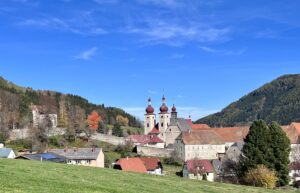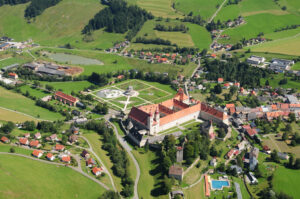


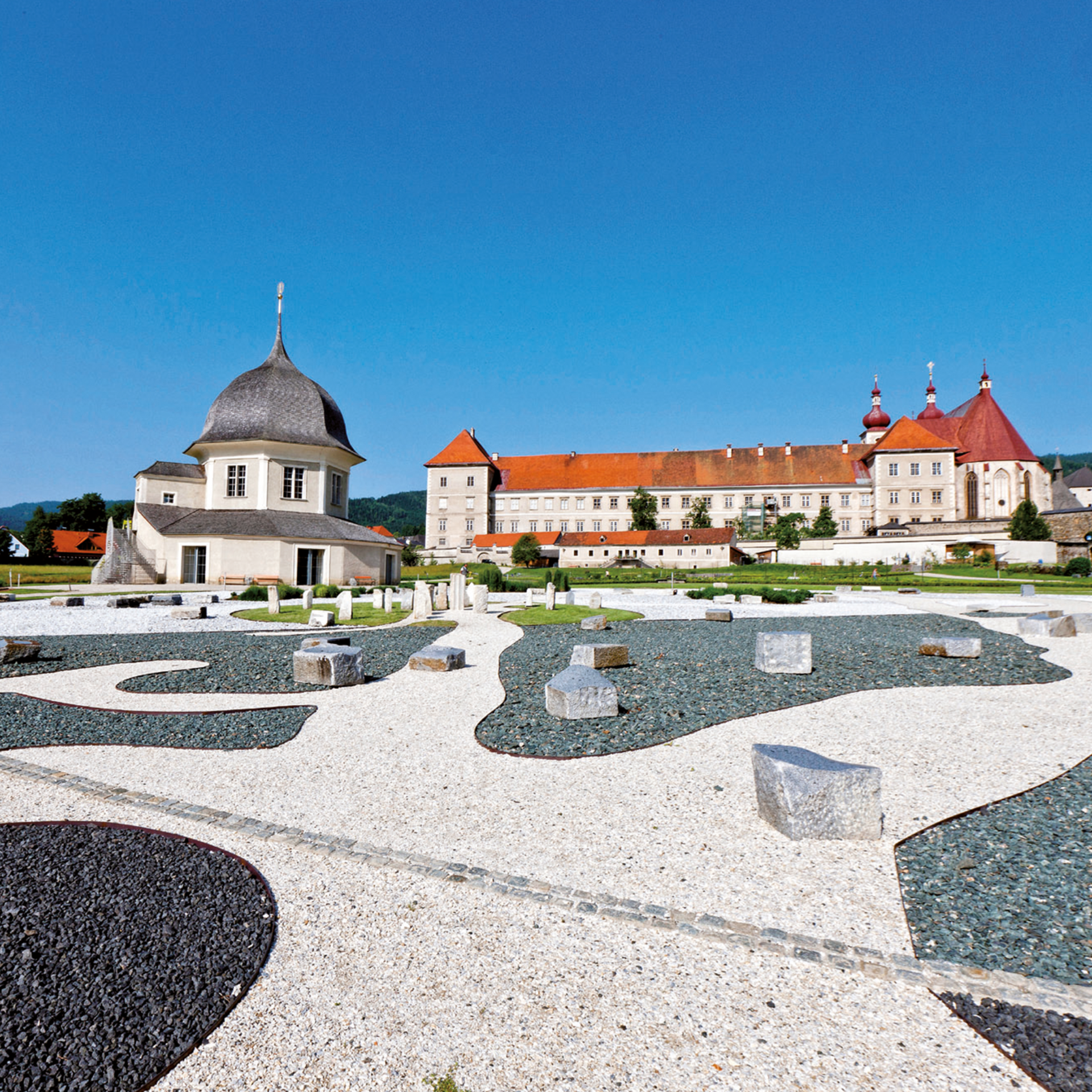
Planning a visit to Stift Sankt Lambrecht? The Benedictine abbey has stood at the heart of the village since 1076, and remains a working monastic community to this day. It was founded by Markward von Eppenstein and completed by his son Heinrich III around 1122. The community survived almost seven hundred years before Emperor Joseph II dissolved it in January 1786, as part of the wider Josephinian monastic reforms; sixteen years later, in 1802, Emperor Franz II reinstated the abbey, and Benedictine monks have lived here continuously ever since. Today, visitors can see the abbey church, the abbey museum, the monastery gardens, and a small monastery shop. The historic abbey library, with around 30,000 volumes, is not open to the public, though individual rooms are occasionally shown on special tours. From our breakfast table, the abbey gates are a 900-metre walk — about ten minutes — and we’re happy to give you a short orientation before you set off.
A short history: 1076 to today
The abbey’s founding falls in a period when the Eppensteiner were among the most powerful noble families in the south-Austrian territories. Markward von Eppenstein founded the monastery in 1076; his son Heinrich III completed the buildings around 1122. Over the following centuries, the abbey grew into a spiritual, economic, and cultural anchor for the Murau region.
In 1786, Emperor Joseph II brought that to a temporary end. As part of his sweeping monastic reforms — which dissolved hundreds of monasteries the imperial administration deemed “useless” between 1782 and 1790 — the abbey at Sankt Lambrecht was suppressed by imperial decree on 4 January 1786. The monks left, the assets were confiscated, and part of the library was transferred to Graz.
In 1802, Emperor Franz II reversed the dissolution. Benedictine monks have lived in the abbey without interruption ever since. In 2026, the community celebrates its 950th anniversary with a year-long programme of concerts, special exhibitions, and liturgical events.
Today the abbey is not a museum but a living monastic community with its own farm and forestry, a boarding school nearby, and active parish work in the surrounding villages. Visitors don’t walk into a historic set-piece — they walk into a place where people still live under the Rule of Saint Benedict, “ora et labora”, pray and work. That makes the experience quieter and more respectful than the average tourist site, and it’s worth holding that in mind as you arrive.
What you can see
Abbey church (Stiftskirche). The abbey church is open daily for visitors when no liturgy is in progress. The late-Baroque interior — high altar, pulpit, side chapels — dates mostly from the 17th and 18th centuries. On weekday evenings, vespers with the conventual mass take place at 6 p.m. and visitors are welcome to attend.
Abbey museum (Stiftsmuseum). The museum holds three collections: an art-historical collection, a folk-history collection, and — perhaps unexpectedly — an ornithological collection of 19th-century stuffed birds. Opening times and admission prices vary by season; check the latest details on stift-stlambrecht.at. We update this post once a year, but the abbey office is the authoritative source for current opening hours.
Abbey gardens and monastery shop. The historic monastery garden is open during the warmer months, and a small shop sells products from the abbey itself — honey, herbal liqueurs, herbs, and books. A nice place to pause after the church.
Baroque nativity scene and Lenten cloths. Two of the abbey’s treasures — a Baroque nativity scene and a set of historic Lenten cloths — are only displayed at certain points in the church year. If you visit during Advent or Lent, ask the abbey office what’s currently on view.
Abbey library. The historic library, holding around 30,000 volumes, is not part of the regular visitor circuit. Individual rooms are occasionally shown on special tours or on the European Heritage Day — ask the abbey office or check the abbey’s website for upcoming dates.
Practical visitor info
Address: Hauptstrasse 1, 8813 Sankt Lambrecht — right in the village centre. From our breakfast table, it’s a 900-metre walk, about ten minutes at a relaxed pace. No need for the car.
Phone: +43 3585 2305-0 · Email: info@stift-stlambrecht.at
Tours. There are general abbey tours and themed tours; seasonality, availability, and prices are listed on the abbey’s website. Booking ahead is sensible, especially during the high season (July–August) and during the 2026 anniversary programme.
Admission. The abbey church is free to enter. The abbey museum charges admission; ask the abbey directly for current rates.
Dress. Shoulders and knees should be covered in the abbey church. A light scarf is enough in summer.
With children. The abbey church and gardens work well with children; the museum is less hands-on (lots of glass cases, less touchable). Tag a stop at the abbey pond onto your visit — that’s our standard suggestion for guests travelling with kids.